


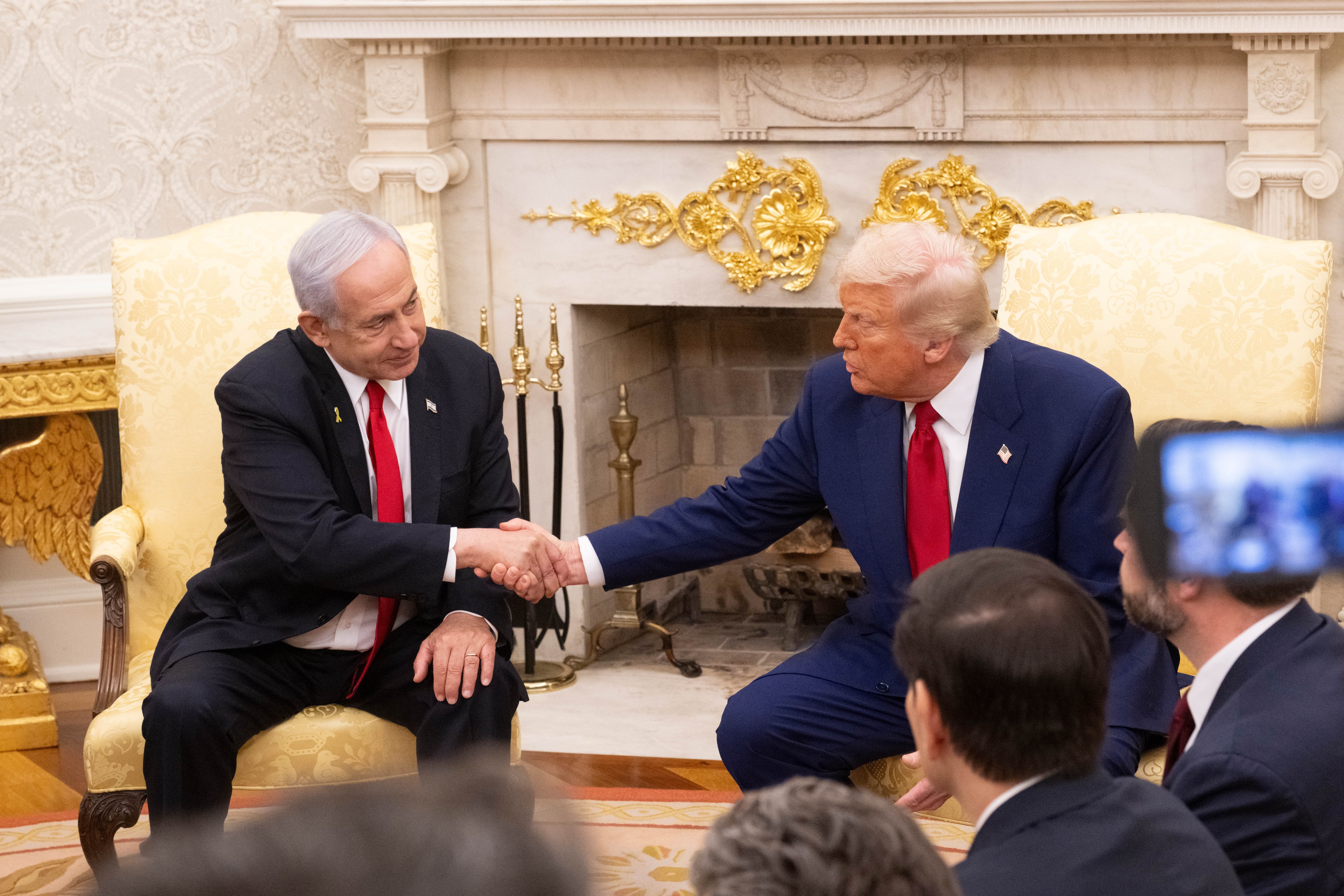
US President Donald Trump and Israeli Prime Minister Benjamin Netanyahu presented a sweeping new proposal on 29 September to end the Gaza conflict.
The plan, dubbed Trump’s 20-point roadmap, emerged after months of intense discussions with key Arab and Muslim partners, including Egypt, Qatar, and Turkey.
Officials said the Doha attack — an Israeli strike that violated Qatari airspace during an alleged attempt to target Hamas negotiators — forced Trump to pressure Israel into halting its offensive.
Trump, freed from domestic political constraints in his second term, felt confident applying leverage over Israel after its military successes in Iran, Lebanon, and Gaza.
By 8 October, he confirmed that Israel and Hamas had signed the first phase of a comprehensive peace deal designed to reshape Gaza’s political and security future.
Ceasefire and Humanitarian Relief Take Priority
The first phase of Trump’s plan demands an immediate ceasefire, suspending all Israeli military operations and freezing frontlines across Gaza.
Within 72 hours, Hamas must release all hostages — both alive and deceased — while Israel must free 250 prisoners serving life sentences and 1,700 detainees arrested since the war began.
The plan also calls for large-scale humanitarian relief, ensuring the safe entry of aid convoys and medical teams into Gaza.
UN agencies and the Red Crescent will oversee the process to guarantee that supplies reach civilians fairly and efficiently.
Trump’s administration insists that these early steps will establish the trust needed for deeper political and security reforms.
International mediators from Egypt and Qatar are expected to monitor compliance and address violations in real time.
Disarmament, Reconstruction, and Political Transition
Once hostages are released, phase two negotiations will begin, focusing on disarming Hamas and stabilising Gaza.
The plan requires the destruction of all Hamas military assets, including tunnels, rocket sites, and command centres.
Trump’s team envisions Gaza transforming into a “de-radicalized, terror-free zone” under joint oversight by the US, Arab nations, and the European Union.
Hamas members willing to disarm and embrace peaceful coexistence will receive amnesty and safe passage for exile.
A multinational stabilisation force will deploy temporarily to train a new Palestinian police unit and secure key infrastructure.
Phase three will establish a transitional administration composed of Palestinian technocrats and international experts under the “Board of Peace,” led by Trump and joined by former UK Prime Minister Tony Blair.
This body will supervise reconstruction projects, restore public utilities, and rebuild housing, roads, and hospitals.
Palestinians choosing to stay and rebuild will receive financial support and guarantees for long-term safety.
The plan allows for potential recognition of Palestine as a state, contingent on successful governance reforms and transparent elections.
Netanyahu, however, rejected the creation of a Palestinian state, declaring on 30 September that Israel would not accept that provision.
Trump maintained that the plan aimed to ensure peace and stability rather than impose political outcomes, emphasizing that progress must come through negotiation, not coercion.
