


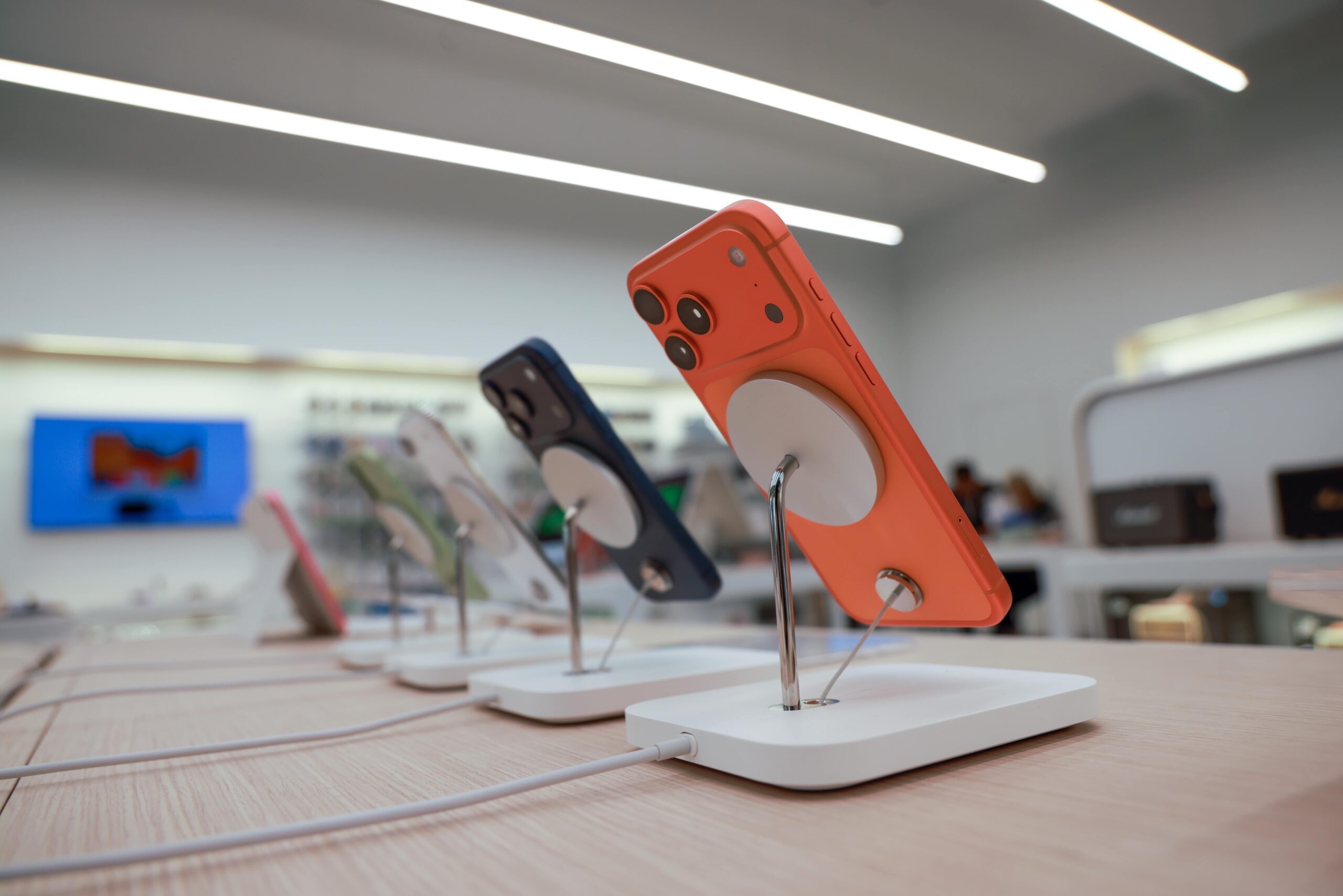
Surging iPhone demand lifted Apple’s revenue during the three months ending in September, closing the fiscal year with record profits. Apple posted stronger-than-expected financial results despite the ongoing global trade war and its rush to compete with other tech giants in artificial intelligence.
Strong initial demand for the iPhone 17 line, launched last month, powered the company’s latest performance. “Apple proudly reports a September-quarter revenue record of $102.5 billion, including record revenue for iPhone and Services,” said CEO Tim Cook.
Driven by iPhone sales, Apple earned $27.5 billion (€23.8bn), nearly doubling last year’s profit. The company’s shares gained 2% in extended trading after the announcement.
Although the iPhone 17 lacks the advanced AI tools featured in Samsung and Google devices, Apple redesigned its models with sleek “liquid glass” displays. It largely held pricing steady despite $1.1 billion (€950m) in tariffs imposed on US-bound products from India and China, with another $1.4 billion (€1.2bn) expected in the next quarter.
Consumers responded strongly, especially in the US and Europe, generating $49 billion (€42.4bn) in iPhone sales for July–September, a 6% increase from last year. Analysts had expected 8% growth, following a 13% rise in the prior quarter.
Ben Barringer, head of technology research at Quilter Cheviot, reported, “Mac sales rose 12%, while iPhone sales climbed about 6%. iPad and wearables remained flat.” He noted that “China’s weakness dragged results down 4% due to forecasting issues and supply limits.”
IDC estimated that Apple sold 58.6 million iPhones worldwide during the quarter, ranking second behind Samsung’s 61.4 million Android sales.
For the fiscal year ending in September, Apple posted record net income of $112 billion (€96.8bn), a 20% annual increase.
Anticipation Builds for the Holiday Quarter
Tim Cook told analysts that he expects strong momentum for the iPhone 17 series through the final quarter of the year. Apple’s chief financial officer, Kevan Parekh, forecasted at least a 10% rise in iPhone sales compared with last year’s holiday season, with total revenue climbing at a similar pace.
“Apple’s Q1 guidance of 10–12% revenue growth looks solid heading into the crucial Christmas period, backed by iPhone 17 demand,” said Barringer.
Investor Optimism Meets AI Challenges
Apple’s stock surged after International Data Corp. signaled record July–September iPhone sales in its preliminary report. The rally pushed Apple’s market value above $4 trillion for the first time and set the stage for further gains in Friday’s trading.
However, investors continue to question Apple’s position in the AI boom. Nvidia’s rise to a $5 trillion valuation underscored Apple’s slower progress. Although Apple promised extensive AI upgrades for last year’s iPhones, it delivered only a few, leaving Siri’s major update delayed until next year.
Barringer warned that uncertainty in China and faster-growing rivals like Microsoft and Nvidia could divert investors. “Some may look elsewhere in the short term,” he said.
Yet Apple has often started late in new technology waves before becoming a dominant force. Wedbush Securities analyst Dan Ives predicted that deeper AI integration could raise Apple’s market value by another $1 trillion (€860bn) to $1.5 trillion (€1.3tr), boosting shares by $75 to $100 each.
