


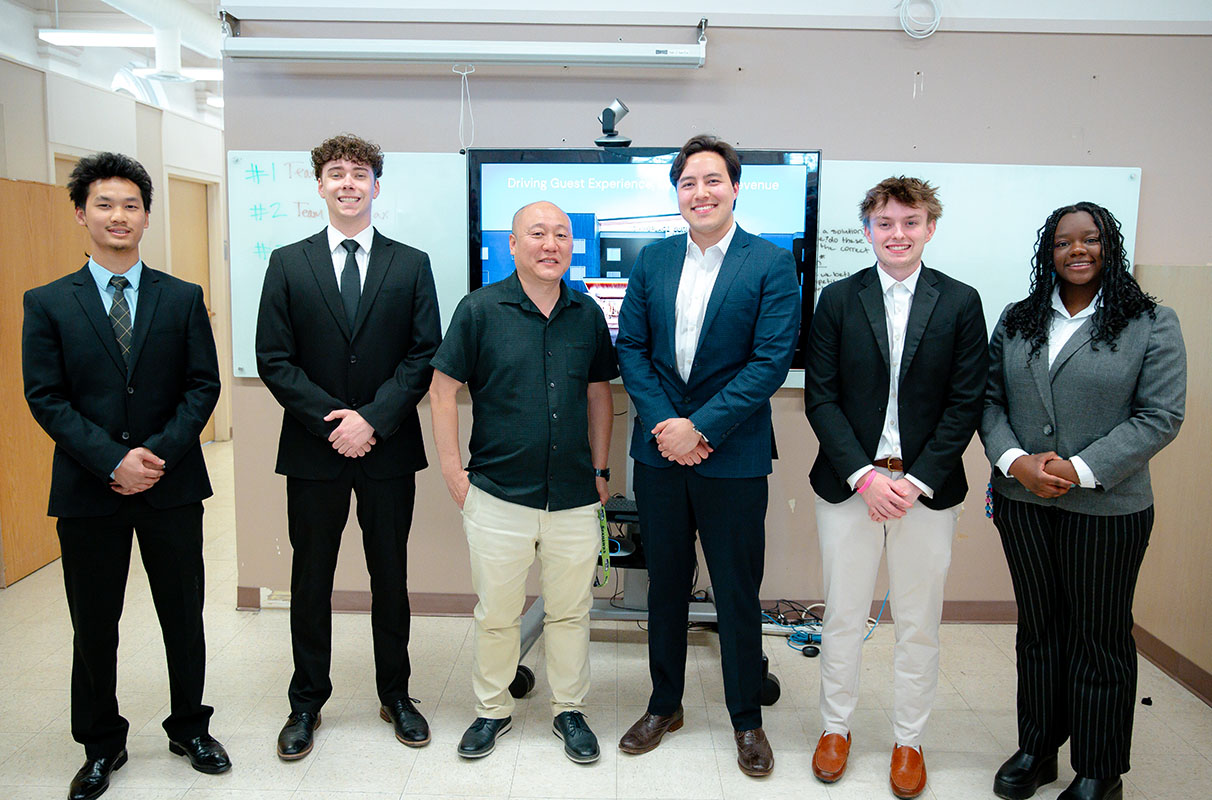
Hotels in Washington State are seeing real changes in how they operate after working with student consultants from Washington State University’s Carson College of Business. Two hotels partnered with students to find better ways to improve service, boost revenue, and enhance the guest experience.
The project was part of a senior entrepreneurship capstone course led by Assistant Professor Asa Brown. Students spent the spring 2026 semester studying hotel operations, analyzing guest data, and visiting sites in person. They then presented their findings in a final pitch competition judged by industry professionals.
The partnership was created with The Hotel Group, a hotel management company led by CEO and Carson College alumnus Doug Dreher. Hotel managers said they were looking for fresh ideas to solve everyday operational challenges and improve performance.
One of the hotels involved was Hilton Garden Inn Redmond. Hotel leaders Angie Martinez and Crystal Pia said they plan to increase dinner service staff based on student recommendations. The student team studied staffing levels, service delays, and revenue performance before suggesting the change.
The students also recommended improvements such as better website functionality, stronger digital marketing, reduced customer wait times, and adding a host during busy service hours. Hotel management said they were already considering staffing changes, but the student analysis helped confirm the decision.
Martinez said the students provided strong cost analysis and practical insights. She said their recommendations showed clear understanding of real hotel operations and guest needs.
Ryan Johnson, a student involved in the project, said the experience felt meaningful because it was based on real business challenges rather than classroom theory. He said the project helped him develop communication skills he plans to use in his future law career.
Another hotel involved was TownePlace Suites by Marriott Ellensburg. A student team led by Grant Shinohara presented ideas focused on guest satisfaction, operational efficiency, and loyalty program growth.
Their recommendations included expanded staff cross-training, improved signage and visual presentation, noise reduction strategies through landscaping and ventilation improvements, and stronger guest loyalty engagement efforts.
They also suggested refining the hotel’s Bonvoy enrollment process and creating an internal leadership group to improve loyalty program performance.
Joseph Nagy, general manager of TownePlace Suites, said he gave the student team the highest score in the pitch competition. He said many of their ideas matched real challenges faced in the hospitality industry and could be implemented in future operations.
Nagy also said he would welcome continued collaboration with Washington State University students, noting that their suggestions were practical and well-researched.
Student Grant Shinohara said working directly with a real hotel made the experience more valuable than a traditional classroom assignment. He said their recommendations were designed to influence real business decisions.
The program reflects a long-standing approach at the Carson College of Business that connects students with real organizations, including small businesses and nonprofits. These partnerships allow students to gain hands-on consulting experience while helping organizations improve performance.
Professor Asa Brown said the goal of the course is to help students think critically and creatively when solving real business problems. He often encourages students to stay engaged with complex challenges until meaningful solutions emerge.
He referenced the idea of persistence in problem-solving, encouraging students to keep working through uncertainty until clear answers are found. The approach is designed to prepare students for professional environments where solutions are not always immediate.
Hotel leaders and students both said the collaboration created benefits on both sides. Businesses received data-driven recommendations, while students gained real-world experience that will help shape their future careers.
The success of the project highlights the growing role of university-industry partnerships in hospitality management, where academic research and practical business needs come together to improve service quality and operational efficiency.
