


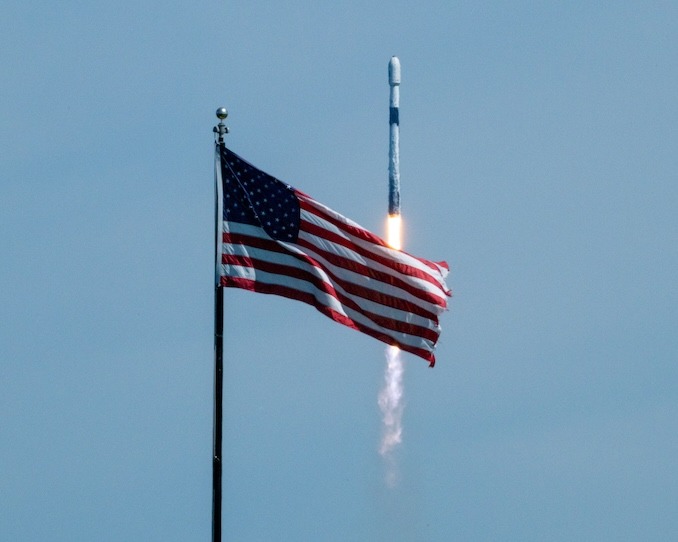
SpaceX reached a major milestone on Sunday when it launched three satellites for SES and completed its 700th Falcon rocket mission. The flight also finished the deployment of the O3b mPOWER satellite constellation, one of the most important communications projects operated by SES.
The mission lifted off from Cape Canaveral Space Force Station in Florida. A Falcon 9 rocket launched from Space Launch Complex 40 at 2:49 p.m. EDT and carried three satellites toward medium Earth orbit.
The spacecraft, named F11, F12, and F13, were built by Boeing and represent the final satellites in the O3b mPOWER system. Their launch increased the constellation to a total of 13 satellites.
The mission was significant for both companies. For SES, it completed a communications network designed to provide high-performance connectivity to commercial, government, and defense customers. For SpaceX, it marked another record in its rapidly expanding launch history.
The company has now completed 700 Falcon launches. That total includes 687 Falcon 9 missions and 13 Falcon Heavy flights.
Launch teams closely watched weather conditions before liftoff. Forecasts showed a mixed outlook, with meteorologists warning that sea breeze activity could trigger showers and thunderstorms near the launch site.
Despite those concerns, conditions remained suitable and the countdown continued without major delays.
SpaceX selected Falcon 9 booster B1080 for the mission. The first-stage rocket has become one of the company’s most frequently flown boosters.
Sunday’s mission was the 29th flight for B1080. During its previous missions, the booster supported flights to the International Space Station, launched the Euclid space observatory, carried the Astra 1P satellite for SES, and delivered multiple batches of Starlink satellites into orbit.
After completing the first phase of the flight, the booster separated from the upper stage and began its return journey.
A little more than eight minutes after launch, B1080 landed successfully on the drone ship A Shortfall of Gravitas in the Atlantic Ocean.
The recovery continued SpaceX’s long streak of booster reusability. The landing was the 166th successful touchdown on that drone ship and the 661st Falcon booster landing overall.
The mission also highlighted the growing importance of Space Launch Complex 40.
The launch became the 400th orbital mission conducted from the historic pad. SpaceX alone has carried out 345 of those launches.
The facility has undergone major upgrades in recent years. New infrastructure added in 2023 enabled the launch site to support both cargo and crew missions using the Dragon spacecraft.
While the launch marked a milestone for SpaceX, it also represented the final chapter of a satellite deployment campaign that began nearly four years ago.
The first two O3b mPOWER satellites were launched in December 2022. Additional pairs followed during several missions between 2023 and 2025.
During the program, engineers discovered an electrical issue affecting some of the early satellites. The problem reduced expected broadband performance and shortened the operational lifespan of certain spacecraft.
To overcome those challenges, Boeing introduced design improvements for later satellites. SES also expanded the constellation plan and ordered additional spacecraft.
Those adjustments helped strengthen the overall network and improve long-term performance.
The final three satellites were delivered to SES earlier this month and prepared for launch in Florida.
Company officials said the completed constellation will support rising demand for broadband connectivity across multiple sectors.
SES executives noted that the satellites already operating in orbit have demonstrated strong performance and confirmed the effectiveness of the system’s architecture.
The three spacecraft were scheduled to separate from the Falcon 9 upper stage beginning roughly 34 minutes after liftoff. Each deployment was planned several minutes apart to ensure safe spacing between the satellites.
Once in their planned positions, the spacecraft will begin orbit-raising activities and technical testing.
Boeing expects the satellites to complete commissioning and enter service by mid-2027.
The completed O3b mPOWER network is expected to expand SES’s capabilities in the medium Earth orbit market and strengthen its position in the global communications industry.
With the successful launch of the final three satellites, SES has completed a key space infrastructure project while SpaceX has added another historic achievement to its growing list of milestones.
