


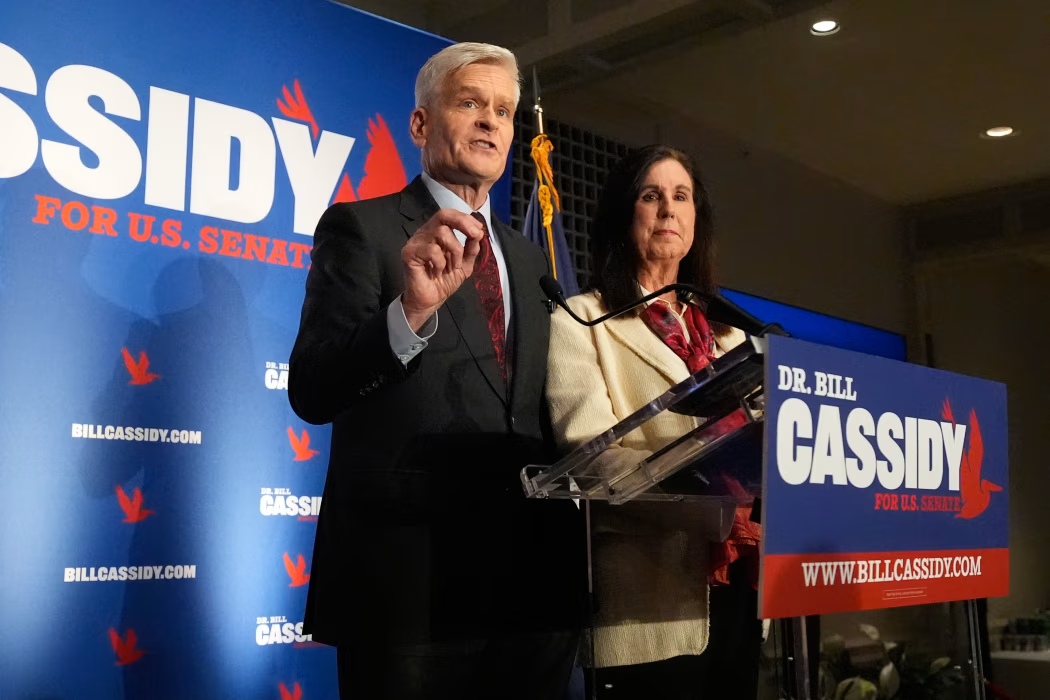
Louisiana Senator Bill Cassidy has suffered a major political defeat in the state’s Republican primary, marking another example of the growing influence of US President Donald Trump over the party’s direction.
Cassidy, a long-time Republican senator and physician, finished third in the primary, failing to advance to the runoff. The result came despite his efforts to align himself with Trump’s policy agenda in recent years.
The election outcome highlights a continuing shift inside the Republican Party, where loyalty to Trump has become a decisive factor for many voters. Cassidy had previously voted to convict Trump during the 2021 impeachment trial following the January 6 Capitol attack, a decision that continued to shape his political standing.
In the Louisiana race, Trump endorsed candidates performed strongly, reinforcing the former president’s influence in local Republican contests. Voters who supported Trump’s preferred candidates said alignment with the president was a key factor in their decisions.
Some voters described Cassidy as inconsistent in his political positioning. Critics argued that his attempt to balance support for Trump’s agenda with past opposition to him ultimately weakened his appeal within the party base.
Cassidy had also taken positions that complicated his standing with different Republican factions. He supported the confirmation of controversial figures in government roles, while also maintaining a cautious relationship with Trump’s political movement.
The primary result now sets up a runoff between Trump-endorsed candidates, including U.S. Representative Julia Letlow and former state official John Fleming. Both candidates have publicly emphasized their support for Trump’s leadership.
Letlow received strong backing from Trump, who described her victory speech as a “great victory” on social media. Her campaign focused heavily on aligning with the former president’s policies and political influence.
The outcome in Louisiana is part of a broader trend across the Republican Party, where Trump’s endorsements continue to shape primary elections and candidate success. Several Republican lawmakers who have opposed him in the past have either lost seats or faced strong primary challenges.
Cassidy’s defeat follows similar political setbacks for Republicans who voted to impeach Trump or publicly challenged his leadership. Some have retired from politics, while others have struggled to maintain support in later elections.
The situation reflects a wider realignment within the party, where ideological differences have increasingly been overshadowed by loyalty to Trump. Political analysts say this has reshaped Republican primaries across multiple states.
After his defeat, Cassidy spoke about principles and constitutional duty without directly mentioning Trump. He emphasized that governance should focus on the broader welfare of the country rather than any single political figure.
However, voter sentiment in Louisiana suggested that Trump’s influence remained central. Many supporters of Trump-backed candidates said they viewed alignment with the former president as essential for securing federal support and political influence.
Some voters also expressed frustration with Cassidy’s past decisions, particularly his vote during Trump’s impeachment trial. Others criticized his handling of key policy votes involving high-profile nominations.
Trump himself reacted strongly to the outcome, praising his endorsed candidates and criticizing Cassidy’s political record. He described Cassidy’s defeat as evidence of the consequences of opposing his leadership within the party.
Other Republican figures have also commented on the trend, noting that candidates who challenge Trump often face significant electoral risks. Supporters argue this reflects voter alignment with his policy direction, while critics see it as a narrowing of internal party debate.
The Louisiana primary is one of several recent contests where Trump’s endorsements have played a decisive role. His influence continues to extend into state-level politics, shaping candidate selection and campaign strategies.
As the Republican Party moves deeper into the election cycle, Cassidy’s defeat is likely to be viewed as another example of the political cost of opposing Trump within the current party structure.
The result underscores the continuing transformation of the Republican Party, where internal divisions, loyalty tests, and Trump’s enduring influence remain central to electoral outcomes.
