


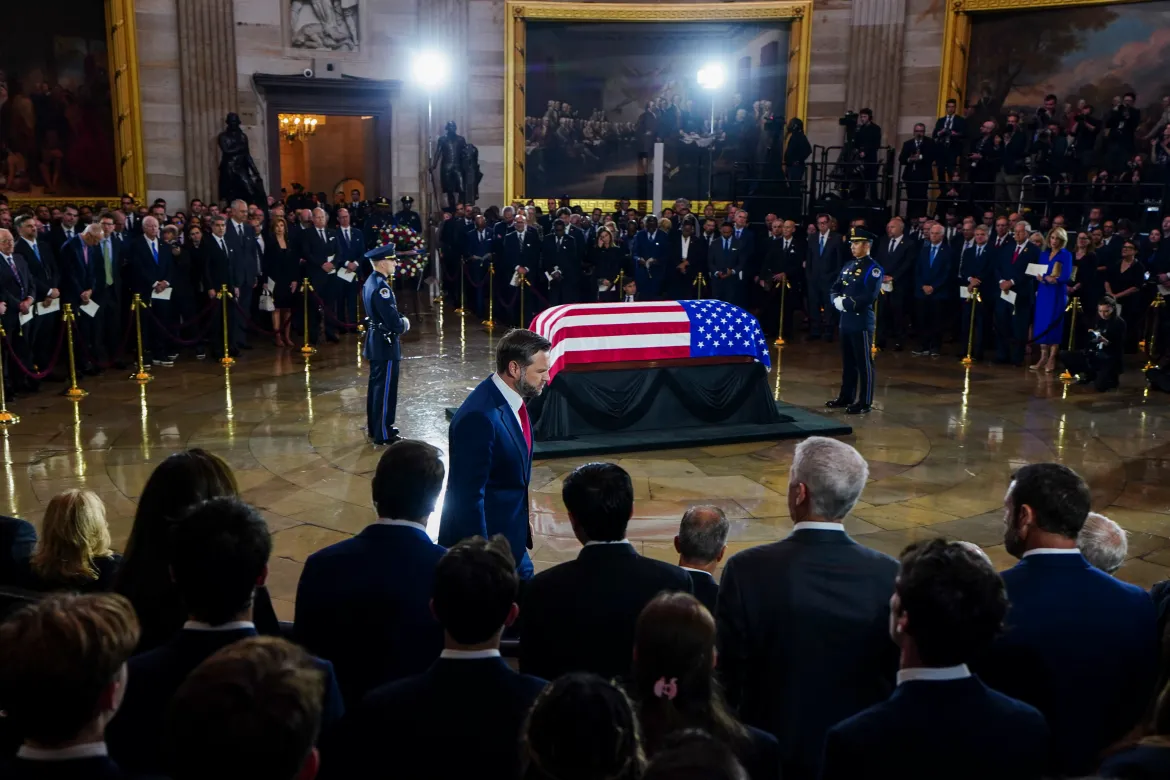
Hundreds of mourners gathered in Washington, DC, on Tuesday to honor former Senator Lindsey Graham of South Carolina during a funeral service that drew senior political figures, foreign leaders, and longtime colleagues.
The funeral took place at the Washington National Cathedral, where attendees paid tribute to Graham’s decades of public service and influence in American politics. The event brought together leaders from the United States and abroad, reflecting Graham’s prominent role in foreign policy and national affairs.
Graham, a Republican senator and close ally of President Donald Trump, died unexpectedly on July 11. His death prompted tributes from political leaders across the United States and from international partners who worked with him during his years in Congress.
President Trump attended the service and delivered remarks honoring his longtime friend. Speaking before mourners, Trump described Graham as a major force in American politics and on the global stage. He called him a beloved friend and praised his commitment to public service.
According to those attending the ceremony, the service focused on Graham’s career, his dedication to public life, and his influence on key national and international issues. Family members, friends, lawmakers, and foreign dignitaries joined together to remember his legacy.
Israeli Prime Minister Benjamin Netanyahu was among the world leaders present at the funeral. Ukrainian President Volodymyr Zelenskyy also attended, highlighting Graham’s close relationships with leaders involved in major international conflicts and diplomatic efforts.
Several other foreign officials and international representatives traveled to Washington for the service. Their attendance reflected Graham’s long-standing engagement in foreign policy matters and his active role in debates on global security issues.
Graham began his congressional career in 1994 when he was elected to represent South Carolina’s third congressional district in the US House of Representatives. He later won election to the US Senate in 2002 and secured re-election in 2008, 2014, and 2020.
During his years in the Senate, Graham served in several influential positions. Most recently, he chaired the Senate Budget Committee. He also served on the Senate Committee on Appropriations, the Senate Judiciary Committee, and the Senate Committee on Environment and Public Works.
Throughout his career, Graham became known for his strong views on national security and foreign policy. He supported the 2003 US-led invasion of Iraq and frequently argued for a more active American role in international conflicts and security matters.
He was also a vocal supporter of Israel and maintained close ties with Israeli leaders. In recent years, Graham backed Trump’s policies toward Iran and supported efforts aimed at increasing pressure on the Iranian government.
Following Russia’s invasion of Ukraine in 2022, Graham became one of the strongest supporters of Ukraine within the US Congress. He regularly called for continued American assistance and met with Ukrainian officials on several occasions.
Colleagues from both political parties remembered Graham as a lawmaker who played a major role in shaping debates on defense, spending, judicial appointments, and international relations. While many disagreed with some of his positions, supporters often pointed to his willingness to engage in difficult political discussions.
The funeral service highlighted the broad impact Graham had during nearly three decades in Congress. Speakers reflected on his commitment to public service, his influence on national policy, and the relationships he built with leaders around the world.
As mourners left the cathedral, many described Graham as one of the most recognizable political figures of his generation. His long career, involvement in major policy debates, and close connections with world leaders ensured that his funeral became a significant gathering of political and diplomatic figures in the nation’s capital.
The ceremony marked a final farewell to a senator whose career left a lasting imprint on American politics and international affairs.
