


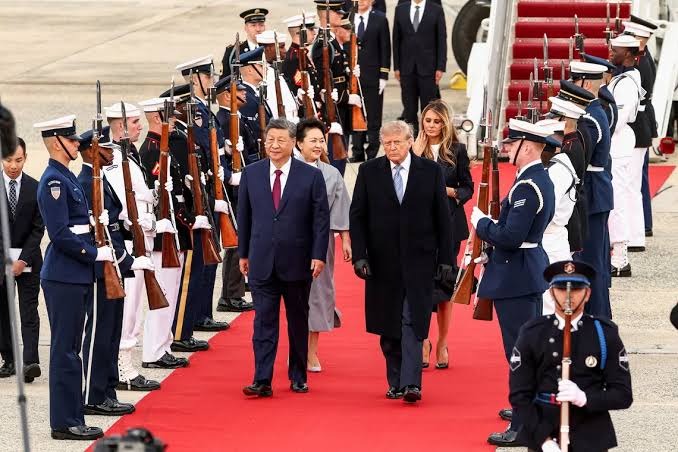
Chinese President Xi Jinping arrived in Washington on Wednesday for a three-day state visit that began with a rare airport welcome from President Donald Trump. The visit opened with both countries agreeing to extend their trade truce until January, giving leaders more time to discuss major issues affecting the relationship between the world’s two largest economies.
Trump personally greeted Xi at Joint Base Andrews outside Washington. First lady Melania Trump joined him as they welcomed Xi and his wife, Peng Liyuan. The ceremony marked an unusual move by the U.S. president, who chose to receive the Chinese leader at the airport instead of waiting for his arrival at the White House.
A red carpet was placed beside Xi’s aircraft. Military representatives lined the welcome area, and an honor guard took part in the ceremony. The event also featured the national anthems of both countries and a flyover by two B-1 bombers.
The visit comes at an important time for U.S.-China relations. Treasury Secretary Scott Bessent announced that both nations had agreed to extend their current trade truce until Jan. 10. The agreement had been due to expire in November.
The trade arrangement allows both sides to continue reducing tensions by avoiding new tariffs and trade restrictions. Officials hope the extension will create more room for talks and help prevent fresh economic disputes.
Bessent said it remains uncertain whether the two countries can reach a broader trade agreement. However, he noted that the extension will provide additional opportunities for discussions during international meetings planned later this year.
Trade remains one of the biggest issues between Washington and Beijing. Over recent years, both governments have faced disagreements over tariffs, exports, technology access, and market competition. While some progress has been made, several areas of concern remain unresolved.
The leaders are also expected to discuss artificial intelligence, security matters, and regional issues during the visit. Relations between the United States and China influence global markets, supply chains, and international politics, making the meetings closely watched around the world.
After arriving in the United States, Xi released a statement calling for cooperation between the two nations. He said China and the United States should work together rather than view each other as rivals. Xi added that both countries can benefit from mutual success and contribute to global development.
The visit has sparked debate among political leaders and policy experts in Washington. Some lawmakers support direct talks between the two governments, while others remain critical of the reception given to the Chinese leader.
Sen. Roger Wicker voiced concerns before Xi’s arrival. He argued that ongoing disputes and tensions with China should remain a key consideration when shaping U.S. policy.
At the same time, administration officials stressed the importance of maintaining communication. Secretary of State Marco Rubio said engagement is necessary because both countries hold major influence in the global economy and international security.
Experts also offered different views on the significance of the airport welcome. Some described it as a diplomatic gesture aimed at supporting stable relations. Others suggested that the event could strengthen China’s international image and provide political value for Beijing.
The decision to extend the trade truce for only a short period also drew attention. China had reportedly hoped for a longer extension. Analysts said the limited timeline may indicate that the United States wants to evaluate China’s progress on previous commitments before agreeing to further measures.
Several observers noted that issues such as agricultural purchases and critical exports remain important parts of the trade discussions. The extension gives both sides time to review progress and continue negotiations.
Trump has not publicly commented on the latest trade extension. More detailed discussions are expected during meetings at the White House on Thursday. The agenda includes economic cooperation, security concerns, and other strategic topics.
The visit will also feature a formal state dinner attended by senior officials and leading figures from the technology industry. As the talks continue, both countries will be looking for ways to manage differences while keeping communication open.
For now, the extension of the trade truce offers a temporary period of stability. The next few months will show whether Washington and Beijing can turn that pause into a broader agreement that strengthens relations and reduces economic uncertainty.
:::writing}
