


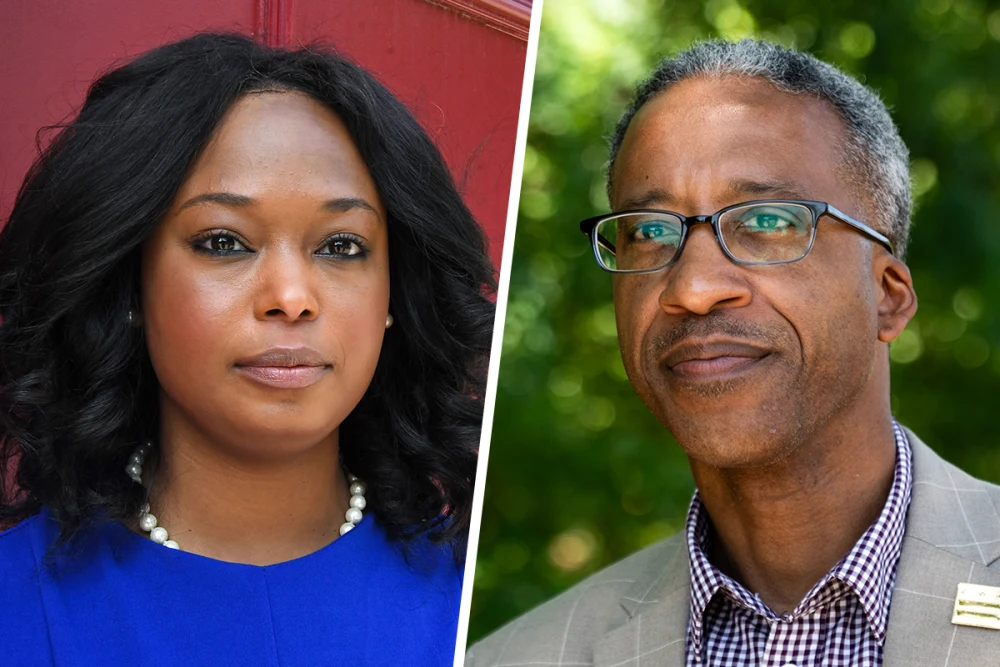
City Council member Janeese Lewis George is leading the Democratic primary race for Washington, D.C. mayor as election officials continue counting ballots, including later-arriving votes that could still affect the final outcome.
With around two-thirds of the expected vote counted, Lewis George holds 53% of first-place votes. Former City Council member Kenyan McDuffie is in second place with 37%. The remaining votes are split among several other Democratic candidates, but the race is currently centered on the two front-runners.
Election officials have said it is still unclear whether the contest will require a ranked-choice tabulation. If no candidate secures an outright majority, votes from lower-performing candidates would be redistributed based on voters’ second and subsequent preferences until one candidate reaches more than 50%.
Despite ongoing counting, Lewis George has established a strong lead over McDuffie. Her performance positions her as the current favorite in the DC mayor primary election, as she moves closer to potentially becoming one of the most prominent democratic socialist figures to win a major city leadership role in the United States.
The campaign has focused heavily on issues affecting daily life in the capital, including crime, affordability, and public safety. Both leading candidates have presented different approaches to addressing these concerns, while also debating how the city should manage its relationship with federal authorities.
Washington’s outgoing mayor Muriel Bowser has also played a role in the political discussion surrounding the race. She has had a mixed relationship with former President Donald Trump, at times cooperating with federal actions while also opposing key decisions. During Trump’s second term, National Guard deployments to the city were part of a broader federal effort aimed at reducing crime in Democratic-led cities.
Bowser recently indicated support for McDuffie, saying the next mayor should help improve the city’s business environment. Her endorsement added a notable dimension to the final stage of the race.
The campaign also drew national attention after Trump commented on the election, suggesting possible federal intervention if Lewis George were to win. His remarks sparked strong responses from both leading candidates, who defended the city’s right to choose its own leadership without outside interference.
Lewis George criticized the comments as an attack on democratic processes, arguing that Washington residents should decide their own mayor. McDuffie also rejected the remarks, saying the city’s future leadership should be determined by voters in the capital alone.
Policy differences between the candidates have also shaped the contest. McDuffie has supported expanding youth curfews as a way to address public safety concerns, describing the idea as a practical solution. Lewis George has opposed the expansion of curfews, signaling a different approach to youth and community policy.
As ballot counting continues, the race remains technically open, but Lewis George’s current lead places her in a strong position heading into the final result. The winner of the Democratic primary is widely expected to have a significant advantage in the general election in the heavily Democratic city.
The final outcome will depend on whether remaining votes shift the balance or trigger a ranked-choice count, but attention is now focused on whether Lewis George can maintain her lead through the final stages of the count.
