


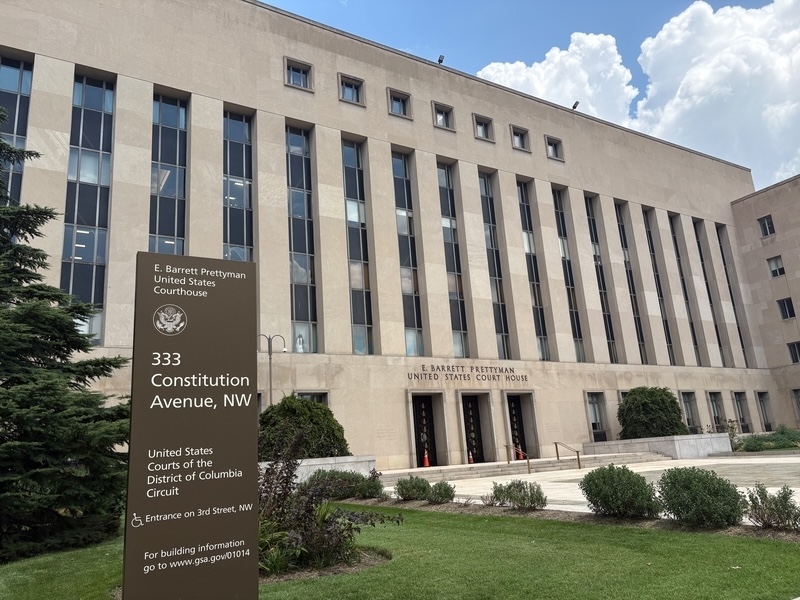
A federal appeals court has temporarily blocked the enforcement of a Trump administration policy against several transgender military members, allowing them to continue serving while a legal challenge moves forward.
The ruling, issued Monday by the U.S. Court of Appeals for the District of Columbia Circuit, represents a significant legal victory for transgender service members who challenged the policy in court.
The case centers on a military policy introduced after President Donald Trump signed an executive order in January 2025. The order was later implemented by Defense Secretary Pete Hegseth and sought to restrict transgender individuals from military service.
In a 2-1 decision, the appeals court upheld a lower court ruling that protects the plaintiffs involved in the lawsuit from being removed from military service while the case continues.
Judge Robert L. Wilkins, writing for the majority, said the policy appeared to target transgender individuals and raised serious constitutional concerns.
According to the ruling, the policy may violate the Equal Protection Clause by treating transgender service members differently without sufficient justification.
Wilkins stated that, at this stage of the litigation, the policy appears arbitrary and motivated by hostility toward a politically unpopular group. Judge Judith W. Rogers joined the majority opinion.
The court’s decision does not permanently strike down the policy. Instead, it serves as a preliminary injunction, which means the legal challenge will continue while the affected service members remain protected.
Judge Justin R. Walker dissented from the ruling. He argued that courts traditionally grant significant deference to military decisions and that service members do not always enjoy the same constitutional protections as civilians.
Walker wrote that judges should be cautious when intervening in military affairs, emphasizing that military leaders are generally responsible for determining personnel policies.
The lawsuit was originally filed by eight active-duty service members and transgender individuals seeking to join the armed forces. Additional plaintiffs have since joined the case.
Legal advocates representing the plaintiffs welcomed the decision.
Jennifer Levi, lead attorney for the plaintiffs, described the ruling as a major victory for transgender military members who have served their country with dedication and professionalism.
She said the decision recognizes the contributions of qualified service members and supports their ability to continue serving while the courts review the policy.
However, the ruling has limited reach. It only applies to the plaintiffs named in the lawsuit and does not automatically protect all transgender service members across the military.
The decision also does not extend to individuals who are currently seeking to enlist in the armed forces.
As a result, many transgender troops remain uncertain about their future.
Kara Corcoran, executive director of SPARTA Pride, an advocacy organization that supports transgender military personnel, said thousands of service members continue to face possible separation proceedings and administrative actions.
Corcoran, an Army veteran with nearly two decades of service, noted that many transgender troops are still waiting for clarity regarding their military careers.
She said the ruling provides important protection for some individuals but leaves many others vulnerable to ongoing policy enforcement.
Legal observers also note that the federal government may attempt to challenge the ruling through additional appeals.
The latest decision follows a similar case earlier this year. In April, the 9th U.S. Circuit Court of Appeals upheld a lower court order that allowed transgender service members involved in a separate lawsuit to remain in the military.
That case, known as Shilling v. Trump, also questioned the legality of restrictions targeting transgender troops.
Despite those lower court victories, the legal landscape remains complex.
In May 2025, the U.S. Supreme Court allowed the Trump administration to enforce a ban on transgender military service while broader legal challenges continued through the courts.
Supporters of the plaintiffs argue that removing qualified service members solely because they are transgender causes significant personal and professional harm.
Advocacy groups say the recent appellate decisions demonstrate growing judicial concern about the impact of the policy on military personnel who have already served honorably.
For now, the latest ruling ensures that the plaintiffs in this case can continue serving while the courts determine whether the policy complies with constitutional protections.
As the legal battle continues, the future of transgender military service remains one of the most closely watched issues in the ongoing debate over military personnel policy and civil rights in the United States.
