


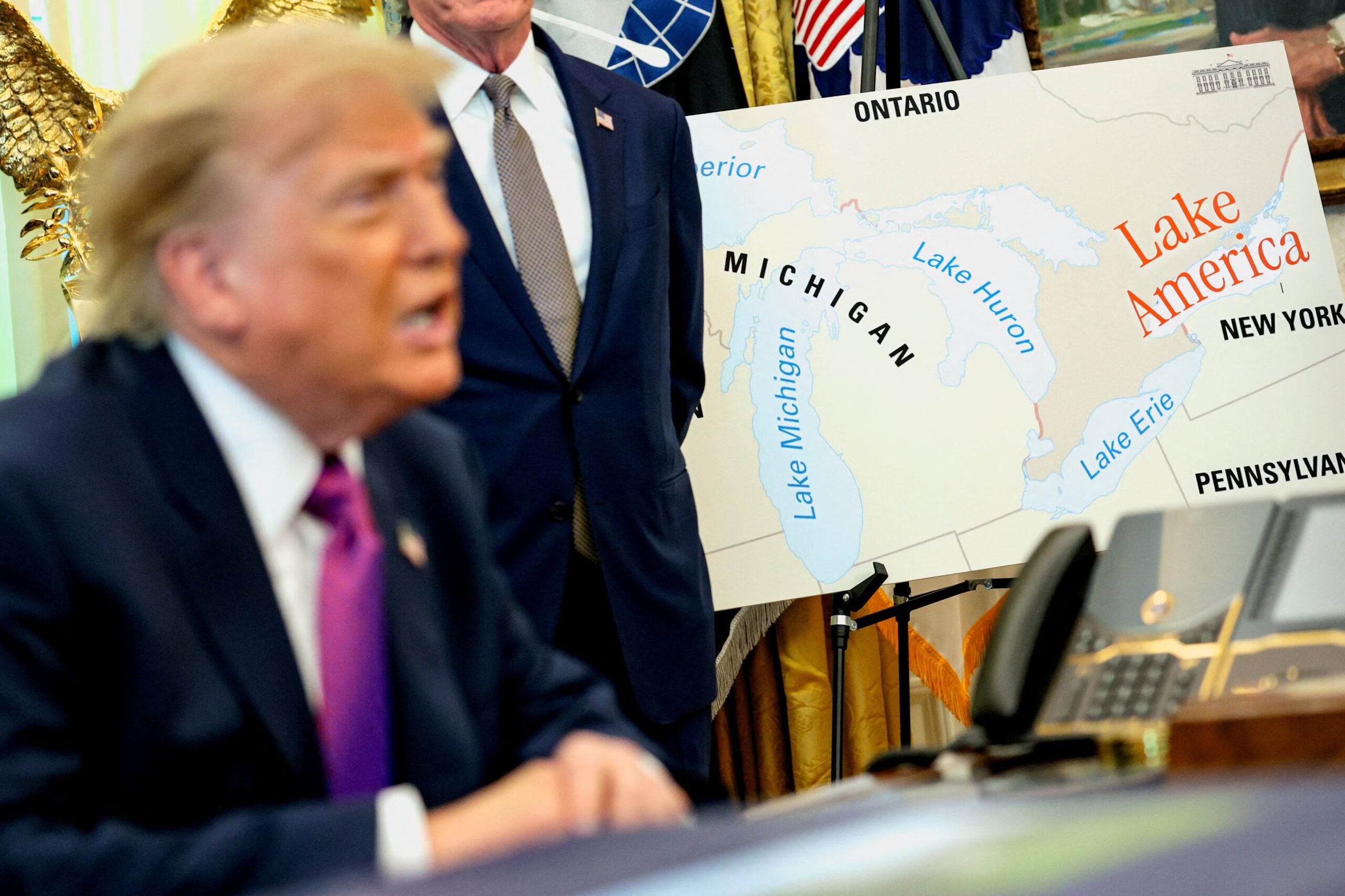
President Donald Trump has signed an executive order directing the United States government to rename Lake Ontario as “Lake America” in official federal records. The decision, announced on Thursday, adds a new point of disagreement between the United States and Canada as trade tensions between the neighboring countries continue to grow.
The order instructs the Interior Department to update the federal geographic naming system and other government databases. Once the process is complete, U.S. agencies will use the name Lake America in official documents and maps. The change applies only within the United States, and Canada is under no obligation to adopt the new name.
Trump signed the order during an event in the Oval Office. Large maps were displayed beside the president as he announced the decision. One map showed the Great Lakes with the words “Lake America” written across Lake Ontario. Another sign featured the slogan “Making the Great Lakes Even Greater.”
While Trump described the action as effective immediately, the executive order gives federal agencies up to 30 days to complete the required updates. The administration said all necessary paperwork had been filed and that government departments had been informed about the change.
The announcement comes during a period of worsening trade relations between Washington and Ottawa. The United States recently imposed tariffs of 50% on approximately $20 billion worth of Canadian products after trade negotiations between the two countries failed to reach an agreement.
Canada responded by placing tariffs on about $20 billion worth of American goods. The measures affect several industries and include products such as steel, dairy items, household appliances, and agricultural equipment. Officials in both countries have defended their positions, while businesses continue to monitor the impact on trade.
Trump has repeatedly criticized Canada on economic and defense issues since returning to office. He has argued that the United States has carried an unfair burden in its relationship with its northern neighbor. He has also made comments suggesting that Canada could become the 51st U.S. state, an idea that Canadian leaders have strongly rejected.
Although Trump said the name change was not designed as a direct political message, he again criticized Canada while discussing the executive order. He argued that the United States could no longer continue what he described as an uneven relationship.
Canadian officials quickly dismissed the decision. Prime Minister Mark Carney defended the lake’s historic name and pointed to its deep cultural and Indigenous roots. He noted that the name Lake Ontario existed long before modern Canada was formed and even before the United States declared independence.
Carney said Canadians recognize the waterway as Lake Ontario and will continue to do so. His comments reflected the position of the federal government, which has no plans to recognize the new U.S. designation.
Ontario Premier Doug Ford also rejected the change. He stated that the lake will remain Lake Ontario for Canadians and for much of the world. Other provincial leaders expressed similar views and questioned the value of altering a name that has been used for centuries.
Nova Scotia Premier Tim Houston criticized the move and described it as unnecessary. His response echoed the broader reaction from Canadian political leaders, many of whom viewed the order as symbolic rather than practical.
Opposition was not limited to Canada. New York Governor Kathy Hochul, whose state borders Lake Ontario, said New York would continue using the traditional name. Her statement highlighted the fact that not all American officials support the change.
The name Ontario comes from the Huron Indigenous word “oniatarí:io,” which translates to “lake of shining waters.” Historians note that the lake gave its name to the Canadian province of Ontario, which was established in 1867.
Experts say there is no single international authority responsible for naming lakes and waterways worldwide. Governments can choose how geographic features are labeled in official records, meaning different countries may use different names for the same location.
The order follows Trump’s earlier effort to rename the Gulf of Mexico as the “Gulf of America” in U.S. government usage. That decision generated debate across North America and beyond.
Before concluding the event, Trump joked that future geographic name changes could be considered. He suggested that after renaming a gulf and a lake, perhaps an ocean could be next. While the comment was made in a lighter tone, the Trump Lake America Order has already become a new source of debate in the ongoing relationship between the United States and Canada.
