


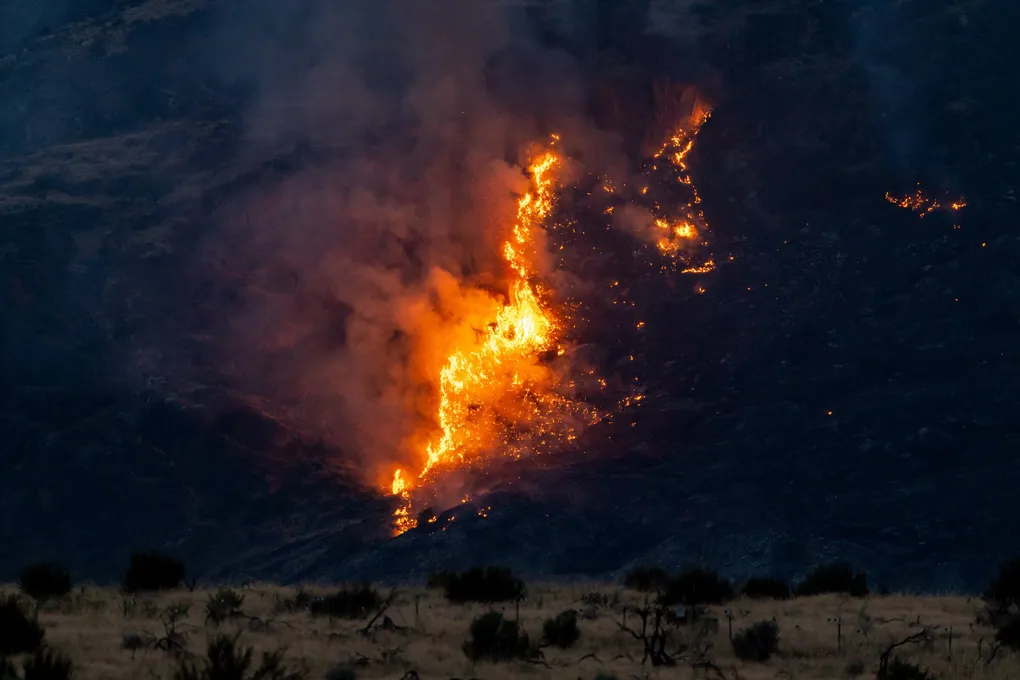
Washington Wildfire Updates show firefighters continue battling several large wildfires across the state as more than 250,000 acres have burned. The largest active fire remains the Kaiser Canyon Fire on the Colville Reservation, where crews are working to protect communities while difficult weather conditions increase the risk of further fire growth.
The Kaiser Canyon Fire expanded beyond 106,000 acres by Friday, making it one of the state’s largest active wildfires. Fire officials reported that the blaze had burned 106,483 acres and was 3% contained as firefighting operations continued.
The wildfire started on July 16 after a lightning strike. Since then, it has spread through timber, brush, and grass across parts of Okanogan County and the Colville Reservation.
Fire crews continue working to slow the fire’s advance while protecting homes, infrastructure, and other important locations. Officials said the highest priority remains safeguarding communities located near the fire’s path.
As the fire expanded, authorities issued additional evacuation orders for residents living in affected areas.
A Level 3 “Go Now” evacuation order remains in effect for both sides of Highway 155 from Coyote Creek Campground to Haley Creek and Haley Creek Road. The evacuation area also extends south toward Omak Lake Road, Columbia River Road, and Kartar Road.
Another Level 3 evacuation was issued for all areas east of Gold Lake Road and 8th Street in Nespelem. Residents in these locations have been instructed to leave immediately because of the approaching wildfire.
Several Level 2 “Be Ready” evacuation notices also remain active across the Colville Reservation and nearby communities. These alerts advise residents to prepare for possible evacuation if fire conditions worsen.
Level 2 evacuation areas include portions of the Colville Reservation stretching from the Okanogan and Ferry County line to Gold Lake Road, Highway 21, Nanamkin Creek Road, and Central Peak Road.
Additional evacuation zones cover areas along Highway 155 between Nespelem and School House Loop Road, as well as locations near the Columbia River, Buffalo Lake Road, Peter Dam Road, South Nanamkin Road, Central Peak Road, Reynolds Resort, and nearby communities.
Emergency officials continue asking residents to monitor local evacuation updates and follow instructions if conditions change.
Weather remains one of the biggest challenges facing firefighters. A Red Flag Warning continues across much of eastern Washington through Saturday at 10 p.m. The warning indicates weather conditions that can support rapid wildfire growth.
Fire officials said a combination of high temperatures, strong winds, and low humidity is creating conditions that could cause fires to spread quickly. These conditions also increase the likelihood of spot fires developing ahead of the main fire.
Because of the dangerous weather, firefighting strategies are focused on protecting lives and property while taking advantage of opportunities to strengthen containment lines when conditions become safer.
Crews are removing vegetation between containment lines and the advancing fire to reduce available fuel. These operations are designed to slow the fire’s movement and improve the effectiveness of suppression efforts.
Ground crews continue working alongside heavy equipment and aircraft when weather conditions allow. Firefighters remain focused on the northwestern and eastern sections of the fire, where communities and critical infrastructure face the greatest risk.
Officials said weather conditions may continue to influence fire behavior over the coming days. Residents living in or near evacuation zones are encouraged to remain prepared and stay informed through official emergency alerts.
The Kaiser Canyon Fire remains the largest active wildfire in Washington, but firefighters continue making progress where conditions allow. Containment efforts are expected to continue as crews respond to changing weather and fire activity.
With more than 250,000 acres burned across Washington this fire season, emergency agencies remain on high alert. Firefighters, emergency managers, and local officials continue working together to protect communities while monitoring wildfire conditions across the state.
