


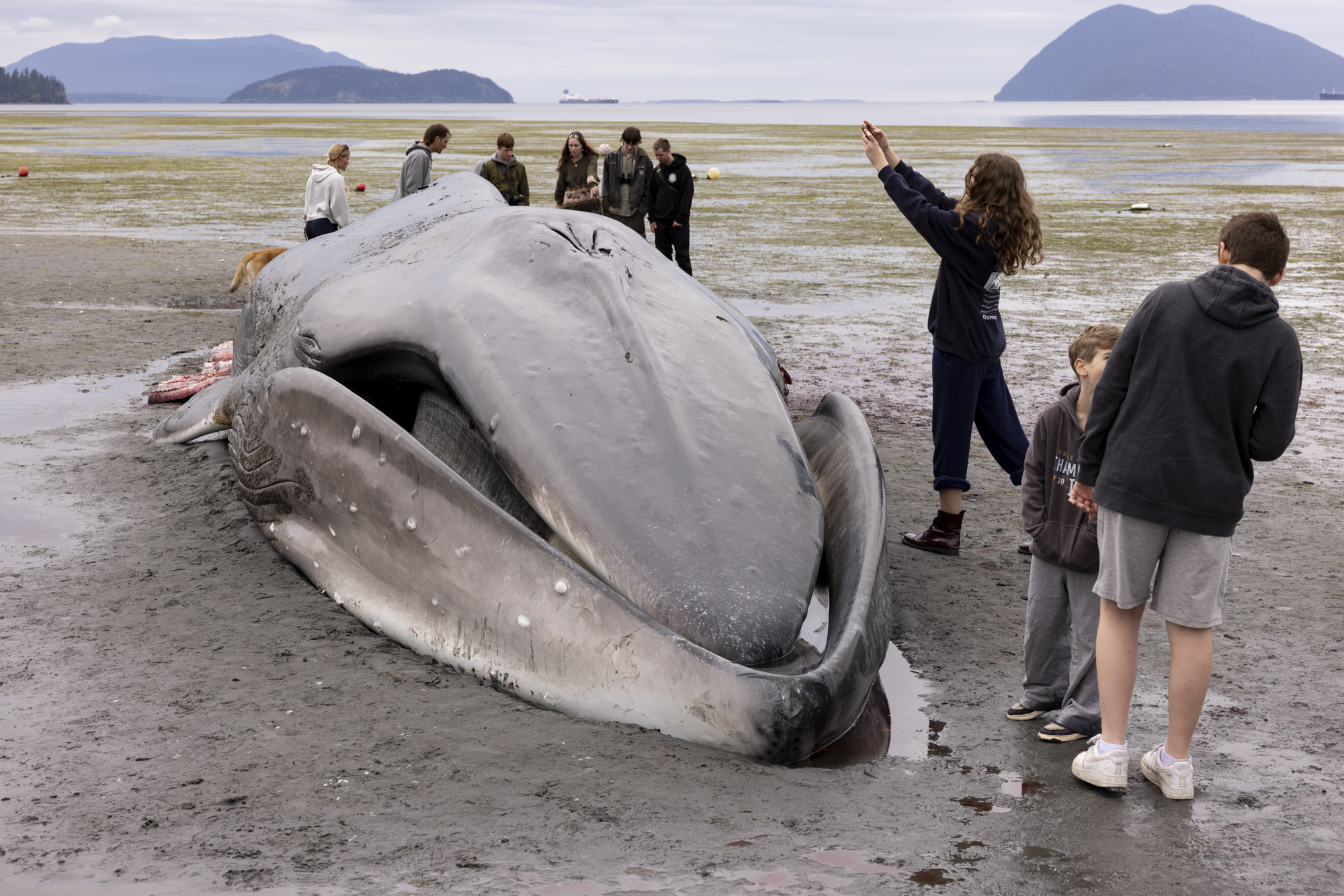
A large 40-ton whale has died after becoming stranded on Samish Island in Washington state, adding to a growing number of whale deaths along the region’s coastline.
The incident occurred on Monday night, when the massive marine animal washed ashore on a gravel beach, according to the National Oceanic and Atmospheric Administration regional office.
By Tuesday morning, researchers had arrived at the scene, but the whale had already died.
Officials confirmed the animal was a male fin whale measuring more than 61 feet in length and weighing around 40 tons.
The fin whale is the second-largest animal on Earth, behind only the blue whale.
Authorities said the whale was in poor condition and appeared severely weakened at the time of stranding.
Experts noted that its body was emaciated, suggesting it had been struggling for some time before reaching the shore.
Because of its enormous size, officials said there are limited options for moving or rescuing stranded fin whales.
The National Oceanic and Atmospheric Administration said a necropsy will be carried out to determine the cause of death.
After the examination, the whale’s remains will be left to decompose naturally at the site.
Marine scientists are increasingly concerned about a rise in whale strandings along Washington’s coastline.
Reports indicate that at least 16 whale deaths have been recorded in the state over the past year.
Experts from the Cascadia Research Collective have also noted a recent spike in strandings since March.
Some researchers believe starvation may be a key factor in the deaths.
They suggest that changes in Arctic and Alaskan feeding grounds, possibly linked to climate-related shifts, could be reducing food availability for whales in the region.
This lack of food may be forcing weaker animals closer to shore, where they eventually become stranded.
Scientists continue to investigate whether environmental changes are playing a larger role in marine mammal deaths.
Officials have urged the public not to approach or attempt to move stranded whales.
They advise anyone who spots a stranded marine animal to contact authorities immediately for proper response.
The National Oceanic and Atmospheric Administration emphasizes that human interaction can be dangerous for both people and animals in these situations.
The Washington Whale Stranding incident highlights ongoing concerns about marine ecosystem health and the challenges facing large ocean species.
As investigations continue, researchers hope to better understand the factors driving the recent increase in whale strandings along the Pacific Northwest coast.
